 The world's narrowest window: How does the North Window in Italy conquer minimalist aesthetics with j
 这场在杭州举行的国家级盛会,成果丰硕!
 2022首届全球数字生态大会圆满举办,共话数字产业发展之道
 Global Luxury Economy Network: Make Financial Management More Diversified
 Ningbo,Zhejiang Province Hosts 2022 World Digital Economy Conference
 Easy Platform Provides More Income Opportunities for Post-pandemic People
|
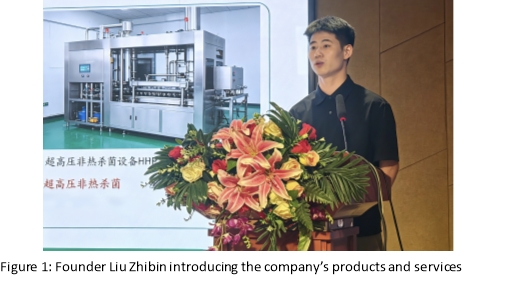
Qyncore Tech is installing and commissioning high-pressure processing equipment in Vietnam. Its young founders see a business opportunity in fruit that cannot be sold fresh, and a test of what Belt and Road cooperation can deliver for rural industries. In Vietnam, a 450-megapascal high-pressure processing system from a young Beijing company had entered installation and commissioning, according to the company. Before it could handle durian puree or mango juice, the team still had to make the equipment work under local factory conditions. For Liu Zhibin, the founder of Qyncore Tech Co., Ltd., that unfinished work is the point. A production line developed in China cannot simply be shipped across a border and switched on, he said. The fruit is different. So are the utilities, the budgets and the people who will operate the machinery. "A mature domestic production line cannot be copied directly into Vietnam," Liu said. "The texture of tropical fruit pulp, local factory water and electricity conditions, and the budgets of small and medium-size processors are all different. Thousands of details have to be optimized again."
Qyncore Tech, a Beijing company founded by young researchers and students from China Agricultural University, is trying to turn those details into a business. The pressure vessel is one part of its proposed product. The company says it will also supply processing methods, installation, operator training, quality-control guidance and maintenance for Vietnamese fruit businesses that want to make juice, puree and concentrate. The effort is still at an early stage in Vietnam. The equipment is being installed and adjusted, not operating as a proven commercial line. No Vietnamese processor, farmer, university or public agency was identified in the source material by name, and no local representative was available in the material to describe the project. For now, the account of its progress, its technical performance and its possible effect on rural incomes comes from the company and its founder. That leaves Qyncore Tech with two tests. One is mechanical: whether equipment developed by a university-linked team can run reliably in a different production environment. The other is economic: whether a technology designed to preserve the taste and color of fruit can be affordable enough to matter outside a laboratory or a well-financed factory. Liu's route to Vietnam began with a recurring problem in food science. Heat kills microorganisms, but it can also alter the food being protected. In experiments at China Agricultural University, Liu compared conventionally heated fruit and vegetable samples with products treated under very high pressure. Heat-sensitive fruits presented the clearest trade-off. "Traditional heat sterilization is widely used, but its strong thermal effect can cause vitamins to degrade, flavor compounds to escape, texture to soften and color to deteriorate," Liu said. High-pressure processing, commonly known as HPP, takes a different approach. Food is sealed and subjected to intense pressure, which can reduce harmful and spoilage microorganisms without the sustained high temperatures used in conventional thermal processing. The method is already used internationally for juices and other packaged foods. It is more accurately described as non-thermal pasteurization than as a universal form of sterilization, because results depend on the organism, product, pressure, holding time and other process conditions. The team developed its equipment with support from research platforms named in the company material, including the Ministry of Agriculture and Rural Affairs Key Laboratory of Fruit and Vegetable Processing, the National Engineering Research Center for Fruit and Vegetable Processing, and the Beijing Key Laboratory of Food Non-thermal Processing. At first, the work was academic: compare samples, measure changes and adjust pressure. The business idea emerged from a narrower observation. According to Qyncore Tech, more than 90 percent of current HPP applications involve liquid foods. The team concluded that equipment designed to handle both solid and liquid products carried functions that many juice processors would pay for but rarely use. Qyncore Tech therefore focused its design on liquids. Its engineers mapped pressure, microbial effect and cost, then selected 450 megapascals as the standard operating level for the system described in the draft. The company says the equipment uses a redesigned pressure multiplier, an electromagnetic plug, a needle-type pressure-release valve, a temperature detection system and fixed protective devices. Those choices were supposed to lower the purchase and maintenance burden. In figures supplied by the company, the design reduced cost by 35 percent, lowered maintenance frequency by 45 percent, kept temperature-monitoring error below 0.1 degree Celsius and more than doubled overall efficiency compared with earlier designs. The company also says the team holds 14 invention and utility-model patents, nine software copyrights and has produced more than 20 academic papers related to the technology. It says the equipment has been assessed by the National Food Machinery Quality Inspection and Testing Center. A domestic demonstration line gave the founders a place to move beyond bench-scale tests, according to the company material. But Vietnam posed a different commercial question. The country produces large volumes of durian, mango, dragon fruit and lychee. Much of the value lies in fruit that meets the appearance, timing and safety requirements of the fresh market. Fruit that is bruised, overripe or cosmetically imperfect has fewer buyers and a shorter clock. The draft supplied by Qyncore Tech describes an export sector exposed to shifts in its largest market. It says China accounted for about 64 percent of Vietnam's fruit and vegetable export value in 2025 and more than 90 percent of its durian exports. It also says tighter testing requirements involving cadmium and auramine O contributed to port delays of more than 10 days for some shipments, while wholesale durian prices fell from 82,000 Vietnamese dong per kilogram to 20,000 to 25,000 dong. The same material cites a sharp fall in mango purchasing prices in Khanh Hoa Province, from 25,000 dong per kilogram to less than 5,000 dong, during a season affected by poor weather and lower output. It estimates Vietnam's annual economic losses from post-harvest spoilage at $3.5 billion to $4.1 billion and says 70 percent of exported products are primary fruit or other low-processed goods. Qyncore Tech's answer is to divert some of that fruit into processed products. A mango with damaged skin may be unsuited for a fresh-fruit display but usable for juice if it meets food-safety and quality requirements. Durian that is ripe and difficult to ship may have value as puree. Processing does not make unsafe fruit safe by definition, and each product would still need controls for raw-material quality, contamination and regulatory compliance. But a reliable processing channel could widen the market for edible fruit that now has little commercial value. That possibility is where the company's youth-entrepreneurship story meets rural development. The founders are not proposing to farm in Vietnam. They are selling equipment and technical services to businesses closer to the farms. If those businesses buy more usable fruit, operate for longer periods and sell products with stable demand, some of the value could reach growers. The size and distribution of that benefit have not yet been measured. Company materials say the team traveled to durian- and mango-growing areas along Vietnam's central and southern coast, where it met planting bases and fruit traders. The documents describe the practical questions that shaped the redesign: the consistency of tropical fruit pulp, available water and power, cold-chain conditions at ports, the technical skills of operators and the capital limits of small processors. This is the less visible part of exporting technology. A machine may meet its specifications in China and still be a poor fit elsewhere. Spare parts may take too long to arrive. A pressure cycle may be technically sound but too slow for the volume a factory needs. Cleaning routines, packaging materials and refrigeration have to fit the product and the local line. Staff members must know how to recognize a fault before it becomes a safety problem. Qyncore Tech says its commercial package is intended to cover those gaps. The company proposes on-site installation, local technical training, process adjustment and quality-control instruction, along with a 48-hour on-site maintenance commitment. Whether that response time is practical will depend on where technicians and replacement parts are based, information the company has not yet disclosed. The Vietnam project also sits inside a larger political and economic frame. China and Vietnam participate in Belt and Road cooperation, and agriculture is one of the areas in which Chinese institutions and companies seek cross-border projects. Qyncore Tech presents its work as a small-scale version of that agenda: Chinese research and equipment moving toward a neighboring agricultural market, accompanied by training rather than a simple equipment sale. That framing gives the founders a public purpose beyond revenue, but it can also make a young company's claims sound larger than its evidence. Rural revitalization is a Chinese policy term with a specific domestic context. Applied to Vietnam, the more defensible question is narrower: can a processing business reduce avoidable losses, create demand for edible lower-grade fruit and support steadier rural income? Answering it requires data from farmers and processors alongside technical measurements from the equipment supplier. Liu describes entrepreneurship as a way to connect his field of study with national priorities and overseas demand. His statement is ambitious, but it also explains why the team chose Vietnam rather than treating commercialization as a domestic engineering problem. "The opportunity for young people in this era is to connect what we have learned with the needs of the country and with the demand for opening up and international cooperation," Liu said. "Entrepreneurship is more than building a company. It is about using Chinese technology to respond to real industrial problems in Belt and Road countries, and allowing agricultural research from China to reach people overseas." For a student-founded company, going abroad early carries risks. The team must sell a capital-intensive product, support it across a border and learn a market where it has no publicly identified local voice in the current material. It must also separate laboratory promise from production performance. Microbial reduction in controlled tests is one resu< consistent output, manageable downtime and saleable products over many months are another. The next evidence will come from commissioning. Engineers will need to show that the pressure system cycles safely, that treated products meet the required microbiological and quality standards, and that operators can repeat the process. A Vietnamese processor will have to decide whether the expected revenue justifies the equipment, utilities, packaging, testing and cold storage. Buyers in China or other markets will then have to accept the finished juice, puree or concentrate at a sustainable price. If those pieces come together, Qyncore Tech could offer a useful model for young researchers trying to commercialize agricultural technology abroad. The model would be modest: start with one defined processing problem, adapt the machinery to local constraints and remain responsible for training and service. Its value would lie in whether factories buy fruit and keep running, not in the language used to describe the project. For now, the machine in Vietnam remains in the installation and commissioning stage. That is a limited milestone, but an honest one. The team has moved its idea beyond a campus laboratory and into a setting where engineering claims will meet factory routines, budgets and a perishable crop. Whether it can also improve the economics of the surrounding countryside is still an open question.
(مصدر:news) |